
Blog · AI
llms.txt file: role, format, and tool to generate it

On this page
Learn what llms.txt may be used for, its still-experimental format, its limits, and how to generate a draft to review.
The llms.txt convention was proposed as a simple way to present selected information and links to AI tools. It remains optional and does not control how AI systems read or understand a site.
What is an llms.txt file, and what are its limits?
The llms.txt file isa small text file (in TXT or Markdown format) placed at the root of a website, such ashttps://tonsite.com/llms.txt. It plays a key role: providinglanguage models (LLMs) with a concise summary and selected links, when those tools choose to support the convention.
If the robots.txt file tells search engines what they can crawl, the llms.txt file tells AI systems what they should understand. It improves the consistency of responses from ChatGPT or other assistants when they reference your site.
Two points of origin, useful for framing the subject. The convention was proposed by Jeremy Howard on 3 September 2024, and its version 2 was published on 10 August 2026. Its author presents it explicitly as "a proposal to standardise", open to community input, not as an adopted standard. That is why no engine is under any obligation to read it. Source: the llms.txt proposal.
Here’s a table to compare the two files:
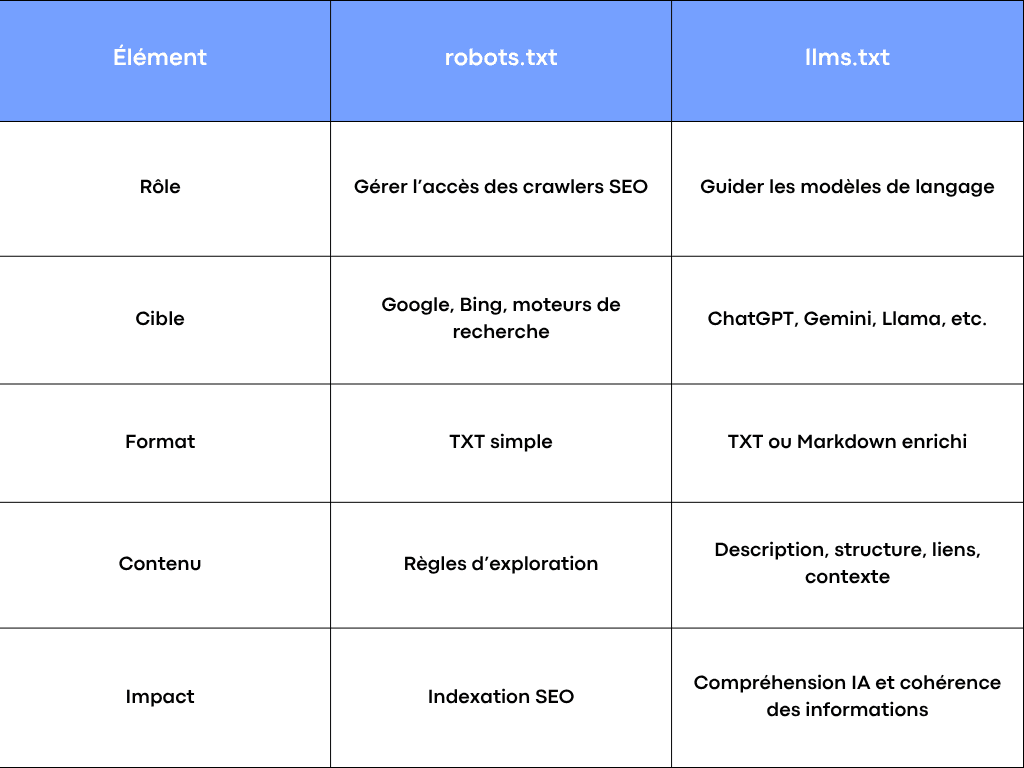
Differences between robots.txt and llms.txt
In short, the llms.txt file doesn’t replace SEO, it complements it. It helps AI systems better represent your business, offerings, and key pages when generating web-based responses.
A point of honesty about actual adoption, which should temper the expectations set above. John Mueller of Google has publicly stated that "no AI system currently uses llms.txt", adding that the file cannot help language-model systems decide which site to surface. His practical recommendation is to create the file the day a platform that actually brings you clients asks for it. In other words: the cost is low, the benefit remains hypothetical. That is not a reason to skip it: it is a reason not to expect traffic from it. Remarks reported by Search Engine Roundtable.
The role of the llms.txt file for your website
The role of llms.txt is tosummarize a site and control of your content in the world of LLMs. AI systems increasingly rely on online data to craft responses. If your site doesn’t provide clear guidance, they may interpret or summarise your content inaccurately.
With a well-structured file, you precisely specify:
- Which content should be considered (product pages, articles, documentation).
- What information summarizes your business.
- Which links are priority to understand your offering.
- Which areas should be ignored (such as /admin or /test).
A consistent llms.txt can avoid presenting outdated information in this file. It is not a demonstrated ranking lever or a message-control mechanism.
llms.txt file format and structure
The llms.txt file is very simple to create. It follows a clear, readable format for any engine or auditing tool. Generally, it uses a structure similar to Markdown to remain readable by both humans and bots.
Here’s an example of an llms.txt file:
# Agence Scroll
> Low-code web agency specialising in Webflow, Payload and automation. Based in France, it builds websites, business applications and AI integrations.
## Services
- [Our services](https://agence-scroll.com/en/services) : offerings, scope and engagement models.
- [Case studies](https://agence-scroll.com/en/use-cases) : delivered projects, sectors and stacks used.
## Resources
- [Blog](https://agence-scroll.com/en/blog) : technical guides on Webflow, Supabase, n8n and AI in business.
## Optional
- [Contact](https://agence-scroll.com/en/book-a-call) : book a call.
That format is not arbitrary: it is what the specification describes. A conforming file contains, in this order, a level-1 heading, the only required section, a blockquote summarising the project, optionally some prose without headings, then zero or more sections delimited by level-2 headings containing Markdown link lists in the form [name](url) : notes. The "Optional" section has a precise conventional meaning: it groups the links an agent may skip when context is short. Specification: the llms.txt format.
Two frequent mistakes are worth correcting here. The first is inventing keys such as site_name: or focus:: that is not Markdown, and no conforming tool will read them. The second carries heavier consequences: llms.txt cannot exclude anything. There is no exclusion directive in the specification, blocking belongs to robots.txt, not to this file. Writing an "exclude" section into it protects nothing and creates a false sense of control.
Each line can present the site name, description, and selected links. This structure is easy for people to read and may help tools that explicitly support the convention, without guaranteeing retrieval.
One clarification that matters if you are starting from scratch: the specification describes a Markdown format, not a key-value one. It calls for an H1 carrying the site name, the only required section, then a blockquote holding a short summary, and finally sections delimited by H2 headers containing file lists, each entry being a Markdown link of the form [name](url), optionally followed by a colon and a note. The example above illustrates the information to gather; to produce a file that conforms to the proposal, this is the Markdown structure to adopt. This site's own file gives a working preview at agence-scroll.com/llms.txt. Source: the llms.txt specification.
Where to place the llms.txt file on your site
, For example:https://tonsite.com/llms.txt
This allows crawlers and models to access it easily.
It works with all CMS, whether WordPress, Webflow, or a custom-built site.
Here are some best practices to follow:
- Check that your file is public and accessible via browser.
- Use UTF-8 encoding to avoid reading errors.
- List URLs in absolute form, never relative.
- Test the file after uploading to verify its readability.
Two mechanisms added in version 2 are worth knowing, because they change how the file is deployed on a sizeable site. The first is the ability to place an llms.txt in a subdirectory: a /docs/llms.txt file covers the pages under /docs/, and where more than one file applies, the agent should use the most specific one. The second is exposing Markdown versions of pages, signalled by rel="alternate" type="text/markdown", and the file describing them by rel="describedby". Those relations can be set as HTML tags or as an HTTP Link: header, which means they can be configured at the server or CDN level without touching a single page. Specification: the llms.txt v2 proposal.
A common mistake is placing the file in a subfolder or using the wrong format. In this case, it won’t be processed by AI.
How to generate your llms.txt file in seconds
To make things easier, Scroll agency has developed a free, online llms.txt generator: llms-txt-generator.agence-scroll.com.
This tool lets you create your llms.txt file without writing a single line of code.
All you need to do is:
- Enter your domain name.
- Select or add your site’s key pages (offers, articles, documentation).
- Generate your file in TXT format, ready to download and place at your site’s root.
The tool follows the currently proposed llms.txt convention and produces a clear draft to review before publishing. It’s compatible with all CMS and can be updated anytime if your offering or content changes.
Avoid these mistakes in your llms.txt file
Here are some tips to keep your llms.txt effective:
Before those tips, a clarification on the expected return. Google's documentation is explicit: "Doing so will neither harm nor help your site's visibility or rankings in Google Search, as Google Search ignores them." The same guide files llms.txt among tactics to ignore, alongside artificial content chunking and inauthentic mentions, and recommends three things instead: technical fundamentals, unique content backed by real expertise, and tracking through Search Console's generative AI performance report. In other words, this file is a service to agents, not a search lever. Documentation: Google's generative AI optimization guide.
- Update your file whenever you add a new important page.
- Be precise in descriptions and links; avoid overly generic text.
- Ensure the content of listed URLs is public and accessible.
- Avoid duplicates between robots.txt and llms.txt: they should be complementary.
- Perform a one-off audit to verify the consistency of the provided information.
Good documentation and a clear structure matter. A well-written llms.txt mainly remains concise, consistent documentation of your key pages.
In short: your quick guide to the llms.txt file
- It is an optional convention, generally written in Markdown, which some tools may choose to read.
- It does not replace SEO fundamentals, and its effect on visibility has not been established.
- It should be placed at the root of your site and updated regularly.
- You can generate it in minutes using the tool developed by Scroll.
You can add it at low cost as a reference summary while keeping site content, internal links, and sources as the priorities.
If you want to go further in optimizing your website, SEO, or implementing effective low-code tools, Scroll agency supports you in strategy, development, and digital visibility for your project.
Frequently asked questions
Does the llms.txt file have a direct impact on SEO?
No direct ranking impact has been established. Google says it ignores llms.txt for Search, so the file neither helps nor hurts Google rankings.
Does Google read the llms.txt file?
Google says it ignores llms.txt for Search. Other tools may choose to use it, but support is neither uniform nor guaranteed.
Does it need to be declared in Search Console?
No, it doesn’t need to be declared. It just needs to be accessible at the root of your site.
Can you use multiple llms.txt files?
No, it’s recommended to have only one per domain to avoid confusion.
Is it compatible with WordPress?
Yes, llms.txt works with WordPress like any other CMS. Simply place it at the root, alongside the robots.txt file.
Related articles
Sep 22, 2026
Jev: the AI model that decides instead of writing
Launched in September 2026 by TypeSafe AI, Jev does not generate text: it returns typed, calibrated decisions. What it is, what it costs, and three use cases.
Sep 07, 2026
How much does an AI project cost, from POC to production?
The model price is not the point. Where the budget actually goes, how to calculate the API versus dedicated server threshold, and what makes it slip.
Aug 28, 2026
AI Act: what actually applies since 2 August 2026
The Digital Omnibus pushed high-risk obligations to December 2027. What already applies, what was postponed, and what to do in between.