
Medical imaging / women's health · UX/UI Design
How Scroll developed dPEI Pocket, a medical app to simplify the assessment of deep pelvic endometriosis
SIFEM – Société d’Imagerie de la Femme is a learned society dedicated to professionals in medical imaging specializing in women's health.
The dPEI Pocket project was born from a real-world need: to simplify and standardize the calculation of the dPEI score, used by radiologists in assessing deep pelvic endometriosis. Until now, this assessment could be complex to formalize, difficult to harmonize among practitioners, and hard for patients to understand.
The concept was to create a simple, reliable, and accessible medical application capable of supporting radiologists in their daily practice while generating a clear, shareable document for other healthcare professionals and patients.
SIFEM reached out to Scroll to turn this business idea into a comprehensive web and mobile application, capable of meeting the real-world constraints of the medical field: quick usage, offline functionality, availability on iOS and Android, educational interface, and structured data.
SIFEM needed to digitize a precise medical process: calculating the dPEI score, used to assess deep pelvic endometriosis.
The challenge was twofold. On one hand, the app had to help radiologists save time, reduce errors, and standardize their practices. On the other, it had to make results more understandable for patients, particularly through a clearer anatomical representation than medical imaging alone.
The project also had to address strong on-the-ground constraints: use in imaging rooms, sometimes without network access, fast experience, desktop, tablet, and mobile compatibility, generation of a shareable document, and publication on iOS and Android.

We designed and developed dPEI Pocket, a web and mobile medical application that simplifies the calculation of the dPEI score based on the 9 anatomical compartments of the pelvis.
The interface was designed to minimize the number of clicks and integrate seamlessly into radiologists' workflows. A visual anatomical representation allows lesions to be positioned and generates a clear report, usable by practitioners and more understandable for patients.
From a technical standpoint, the project required a robust architecture: responsive application, mobile encapsulation with CapacitorJS, offline mode management, data synchronization, reliable PDF generation on both desktop and mobile, and structuring of anonymized data to enable statistical analysis by region.
The application was developed with Plasmic and Supabase, then adapted to work in mobile and offline environments using SQLite.
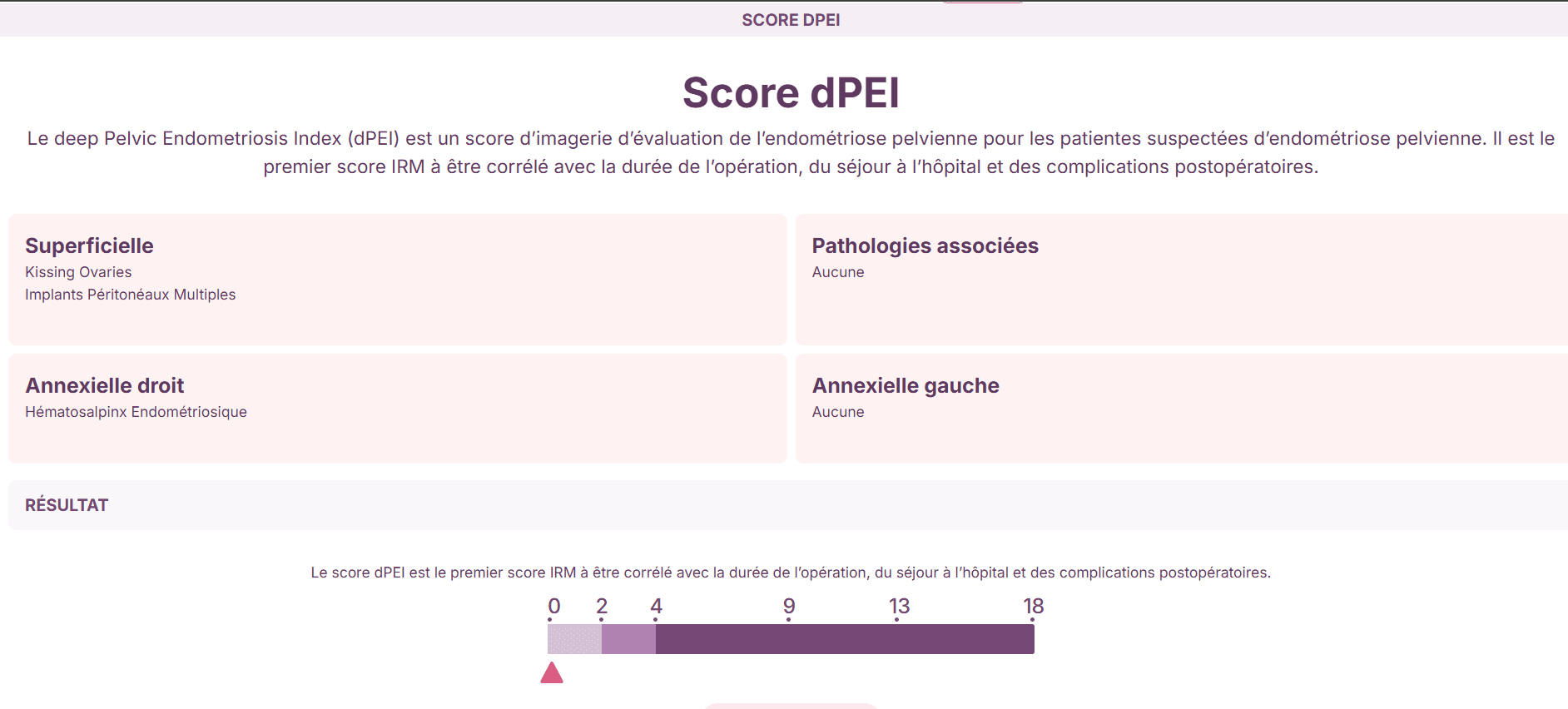
dPEI Pocket now enables SIFEM to offer radiologists a reliable, easy-to-use digital tool tailored to the real-world constraints of the medical field.
The app facilitates more consistent assessment of deep pelvic endometriosis, improves the readability of results for patients, and streamlines information sharing among the various professionals involved in patient care.
This project demonstrates Scroll’s ability to design and develop complex business applications, combining UX, medical logic, advanced technical constraints, offline mode, mobile apps, and structured processing of sensitive data.