
Blog · AI
Beyond SEO and SEA, Enter GEA with ChatGPT Ads
On this page
With ChatGPT Ads, advertising enters AI-generated conversations. This new lever, called GEA, may soon complement SEO, SEA, and GEO in acquisition strategies.
For over twenty years, online visibility has relied on two major levers. SEO enabled brands to rank in organic results. SEA allowed them to buy ad space.
The rise of generative engines has already shifted this dynamic. Users no longer just type a few words into Google. They ask detailed questions, provide context, and expect answers tailored to their situation.
GEO, or Generative Engine Optimization, emerged to address this new behavior. Its goal is to improve a brand’s presence in responses generated by ChatGPT and other AI systems.
A new phase has now begun with ChatGPT Ads.
Since August 24, 2026, ChatGPT Ads have been available in France and several other European countries. Access is initially granted to OpenAI teams, partner agencies, and technology partners. Self-service access via Ads Manager is expected later this quarter.
The scale of the rollout is worth spelling out, because it changes what is at stake: OpenAI's 18 August 2026 announcement covers 31 European countries, Germany, France, Spain, Italy, Sweden, Norway, Denmark, the Netherlands, Austria and the rest, served from Monday 24 August. This is no longer a quiet pilot: it is the largest geographic advertising expansion OpenAI has run since the US pilot launched in February 2026. Official announcement: ChatGPT Ads expands across Europe, and Search Engine Land's detailed write-up.
This development paves the way for GEA, or Generative Engine Advertising.
What is GEA?
In this article, GEA refers to the purchase of advertising visibility within generative engines.
Generative Engine Advertising follows the same principle as SEA but adapts it to tools like ChatGPT. A company no longer seeks to appear after a keyword search. Instead, it aims to be visible during a conversation tied to a need, project, or decision.
Let’s take a simple example.
A business leader might ask ChatGPT:
"Which tool should I choose to automate lead tracking with a team of five salespeople?"
This query contains far more information than the keyword "CRM software." It specifies the need, team size, intended use, and the prospect’s maturity level.
This is the core value of GEA. AI advertising can integrate into a rich context, precisely when someone is comparing solutions.
OpenAI itself presents ChatGPT Ads as a way to reach users as they explore options, evaluate choices, and make decisions.
The term GPT Ads is sometimes used to describe this format. However, the official name remains ChatGPT Ads.
Why ChatGPT Ads is reshaping online advertising
Traditional SEA relies heavily on keywords.
Advertisers select the searches they want to appear for. They set a bid, write an ad, and direct users to a landing page.
GEA operates with a richer medium: conversation.
ChatGPT’s ad system can consider the context and intent of the ongoing dialogue. It also analyzes the landing page, ad title, description, and advertiser-provided signals. Relevance and bid then determine the ranking of eligible ads.
This doesn’t mean keywords are obsolete. They become part of a broader framework.
A ChatGPT ad campaign will need to understand the topics prospects discuss, their constraints, decision criteria, and the questions they ask before purchasing.
The task will no longer be limited to buying a keyword. It will involve covering a range of scenarios.
This conversational advertising can appear at multiple stages of the customer journey. It can support brand discovery, solution comparison, or the call to action.
SEO, SEA, GEO, and GEA: four complementary levers
The arrival of Generative Engine Advertising does not make SEO or SEA obsolete. It adds a new touchpoint.
SEO aims for organic visibility in search engines. It relies on content, technical site structure, backlinks, and overall user experience quality.
SEA allows for immediate paid visibility in sponsored results. It remains highly effective for capturing demand expressed through precise keywords.
GEO seeks to make a business understandable and credible to generative engines. The goal is to increase the chances of being cited, mentioned, or used as a source in a response.
GEA enables the purchase of an ad placement tied to the context of a conversation.
The distinction between GEO and GEA is critical.
A ChatGPT Ads campaign does not allow payment to alter an organic response. OpenAI states that ads are separate from responses and cannot influence their content. They appear below the response, with a clear label indicating their advertising nature.
OpenAI's own wording is explicit here: "advertisers don't receive users' conversations, and advertising doesn't influence the answers ChatGPT generates". Two practical consequences for a marketing team. First, no budget will buy back a weak organic position inside an answer: that is GEO's job, and it remains entirely to be done. Second, targeting does not draw on conversation history, the usable context is the exchange in progress.
GEO thus focuses on organic visibility within ChatGPT. GEA focuses on paid visibility around that response.
Both approaches can work in tandem. A brand well-structured for AI referencing will often have better content, clearer pages, and a more precise positioning. These elements can also strengthen the coherence of an advertising campaign.
How does advertising work in ChatGPT?
The initial format of ChatGPT Ads remains close to known standards.
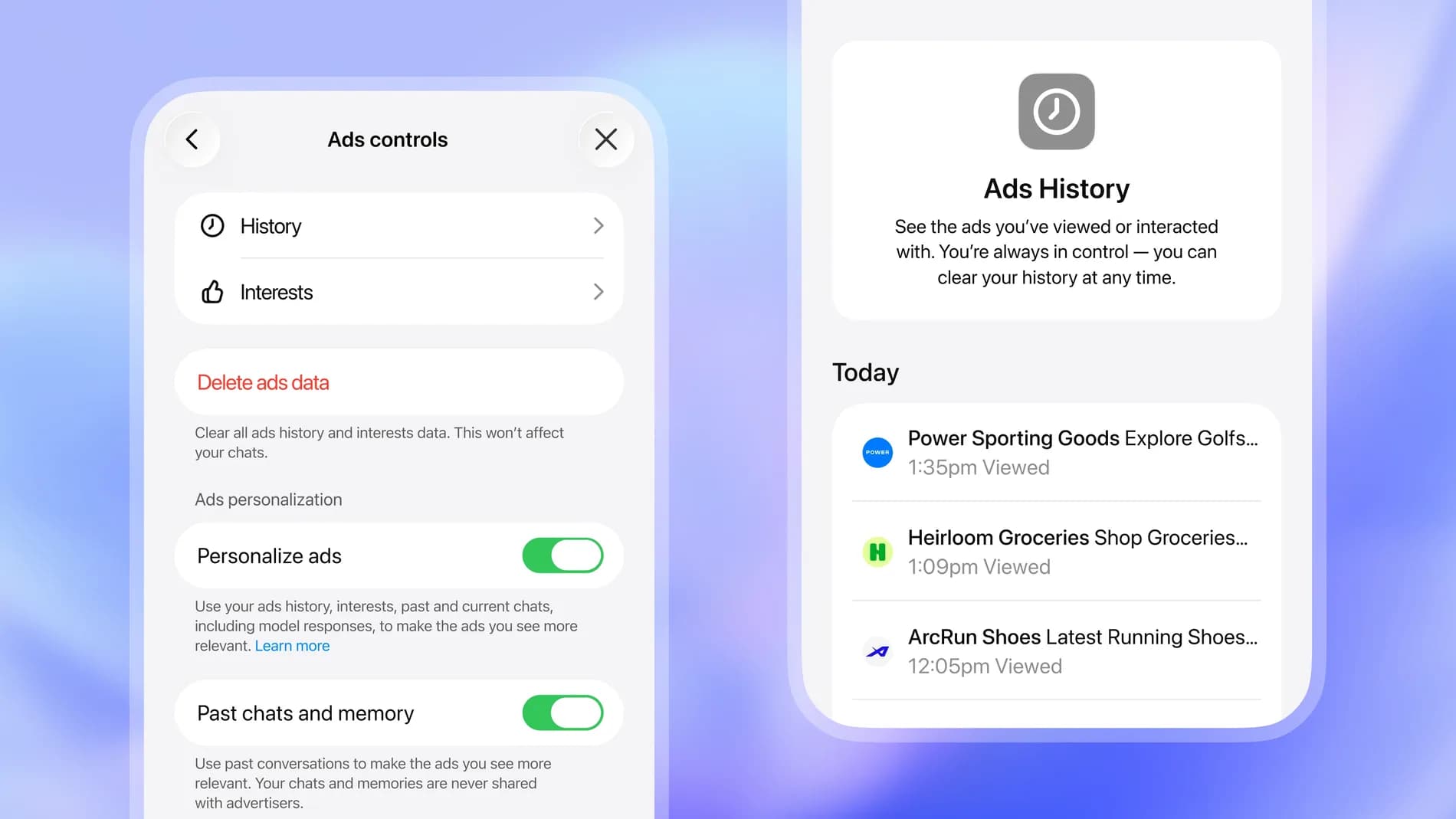
An ad can include the advertiser’s name, logo, a title, a description, an image, and a link to a landing page. It appears below a response generated by ChatGPT.
Ads can be purchased on a CPM or CPC basis.
CPM corresponds to payment per thousand impressions. It is best suited for reach and brand awareness objectives.
CPC corresponds to payment per valid click. It better aligns with traffic, lead generation, or sales goals.
OpenAI has also added conversion optimization, geographic targeting, and custom audiences. Measurement can be done via the OpenAI pixel, a conversion API, or third-party integrations.
Advertisers can track impressions, clicks, spend, click-through rate, average CPC, average CPM, and conversions. UTM parameters can also be added to links for traffic analysis in external tools.
In France, the regulatory context will also impact targeting. OpenAI notes that expanded ad personalization is not available at launch in the European Economic Area. However, the context of the ongoing conversation can be used to select a relevant ad.
A GEA strategy is more than just creating an ad
On Google Ads, two companies can bid on the same keyword. In ChatGPT, they’ll also need to prove their offer matches the problem described in the conversation.
One audience parameter is decisive before committing a budget, and it is rarely mentioned: ads only appear for users on the Free and Go plans. Pro and Enterprise accounts stay ad-free. For a B2B offer, that means a share of the best-equipped decision-makers, the ones whose company already pays for a subscription, is structurally out of reach for GEA. On that segment, the only possible visibility inside ChatGPT is organic, so GEO. Source: which plans see the ads.
Preparing a GEA campaign therefore starts with mapping user intent.
A business must understand what its prospects are trying to solve. It needs to know the questions asked before purchase, comparison criteria, objections, and the constraints blocking the decision.
The landing page then plays a central role.
A vague, overly salesy, or poorly structured page risks sending the wrong signals. Conversely, a clear page helps users quickly grasp the offer, target audience, benefits, and use cases.
For an automation agency, a generic page about “artificial intelligence” is often too broad. A dedicated page on sales follow-up automation for SMEs will be far more precise.
The ad message must also remain useful.
In a generative engine, users seek answers. An overly aggressive ad may seem out of place. The right message extends the thought process by offering a solution aligned with the expressed need.
The quality of GEA will thus depend on three levels:
- understanding the conversations tied to the market;
- the precision of ads and landing pages;
- the actual measurement of leads, sales, and generated revenue.
This approach brings advertising even closer to content, positioning, and customer experience.
Why GEO should be addressed before GEA
GEO and GEA serve different goals, but they share a common foundation.
To gain visibility in ChatGPT, a business must present easy-to-understand information. Its offer must be well-defined. Its content must provide direct answers. Its proof points must be visible.
This work helps generative engines understand the brand. It also helps prospects who arrive after clicking a ChatGPT ad.
A GEO strategy can therefore pave the way for GEA.
It enables the creation of pages tied to real customer intent. It improves consistency between a conversation, an ad, and the page visited. It also reduces the risk of buying traffic to overly generic content.
GEA should not be used to compensate for a confusing website.
Before investing in GPT Ads, a business must ensure its messaging is clear. It must also be able to explain in a few sentences who its offer is for, what problem it solves, and why it’s credible.
Which businesses should consider GEA?
Generative Engine Advertising can apply to many industries.
Software publishers can reach prospects comparing multiple tools. E-commerce brands can appear during product searches. B2B service providers can capture demand tied to a specific problem. Local businesses can leverage geographic targeting to promote an offer in a given area.
GEA seems best suited to markets where customers need to think before purchasing.
The more a decision requires comparing options, the more a conversation can reveal a useful intent. This applies to software, professional services, training, equipment, travel, or certain high-value purchases.
However, caution is still required.
ChatGPT Ads is still a young platform. Formats, rules, and measurement tools will evolve. It’s too early to guarantee a low cost per click or a better ROI than Google Ads.
Early campaigns should therefore serve as learning opportunities. A useful test doesn’t just seek clicks, it checks visitor quality, conversion rates, cost per qualified lead, and the commercial value generated.
How to measure a ChatGPT Ads campaign?
Classic advertising metrics remain useful. Click-through rate shows if the ad grabs attention. CPC measures traffic cost. Conversion rate indicates whether the page meets the need.
But a GEA strategy must go further.
For a B2B company, form submissions alone aren’t enough. You need to know how many requests match the target, how many turn into meetings, and how many result in a sale.
For e-commerce, track average order value, purchase rate, margin, and new customers.
This measurement requires a reliable technical foundation. Conversion tracking, UTM parameters, CRM, and sales data must be connected. Without this, a campaign may appear successful while generating little value.
GEA can be prepared now
After SEO, SEA, and GEO, GEA adds a new layer to online visibility.
The companies that succeed won’t just be those buying ads. They’ll be the ones that understand customer intent, structure their content, and measure every step of the journey.
The right starting point is to audit the existing setup. This means assessing brand visibility in generative engines, the quality of landing pages, and the conversations that precede a decision.
At Scroll, we support SMEs through this transition. The goal is to connect GEO strategy, content, automation, and future ChatGPT Ads campaigns. A practical approach to test GEA without isolating this new channel from the rest of acquisition.
Frequently asked questions
What does GEA stand for?
GEA stands for Generative Engine Advertising. The term refers to paid advertising within generative engines. ChatGPT Ads is currently the most visible example.
What’s the difference between GEO and GEA?
GEO aims for organic brand presence in AI-generated responses. GEA refers to paid ad placements. An ad does not influence ChatGPT’s organic response.
Is ChatGPT Ads available in France?
Yes. ChatGPT Ads has been available in France since August 24, 2026. Initial access is via OpenAI and its partners. Standalone Ads Manager deployment in France is announced for later in the quarter.
Who can see ads in ChatGPT?
Ads may be shown to users on Free and Go plans. Plus, Pro, Business, Enterprise, and Edu accounts remain ad-free. Accounts identified as belonging to minors do not receive these ads.
Will GEA replace SEA?
No. SEA remains effective for precise searches on traditional engines. GEA adds a channel based on conversation and context. Businesses will need to allocate budgets based on their target audience’s usage.
Read next
Guides on the same topic
Explore the topic further with a selection of complementary resources.
Sep 22, 2026
Jev: the AI model that decides instead of writing
Launched in September 2026 by TypeSafe AI, Jev does not generate text: it returns typed, calibrated decisions. What it is, what it costs, and three use cases.
Sep 07, 2026
How much does an AI project cost, from POC to production?
The model price is not the point. Where the budget actually goes, how to calculate the API versus dedicated server threshold, and what makes it slip.
Aug 28, 2026
AI Act: what actually applies since 2 August 2026
The Digital Omnibus pushed high-risk obligations to December 2027. What already applies, what was postponed, and what to do in between.