
Blog · Web development
Auth0 or Keycloak: Which SSO Solution for Your Application?
On this page
Auth0 (managed and fast), Keycloak (open source and sovereign), Supabase Auth (built-in). How to choose your authentication layer.
Any serious application needs authentication: login, role management, sometimes enterprise SSO. Three options stand out, Auth0, Keycloak, and your database’s built-in solution. The choice hinges on sovereignty and operational effort.
Auth0: Managed, Quick to Integrate
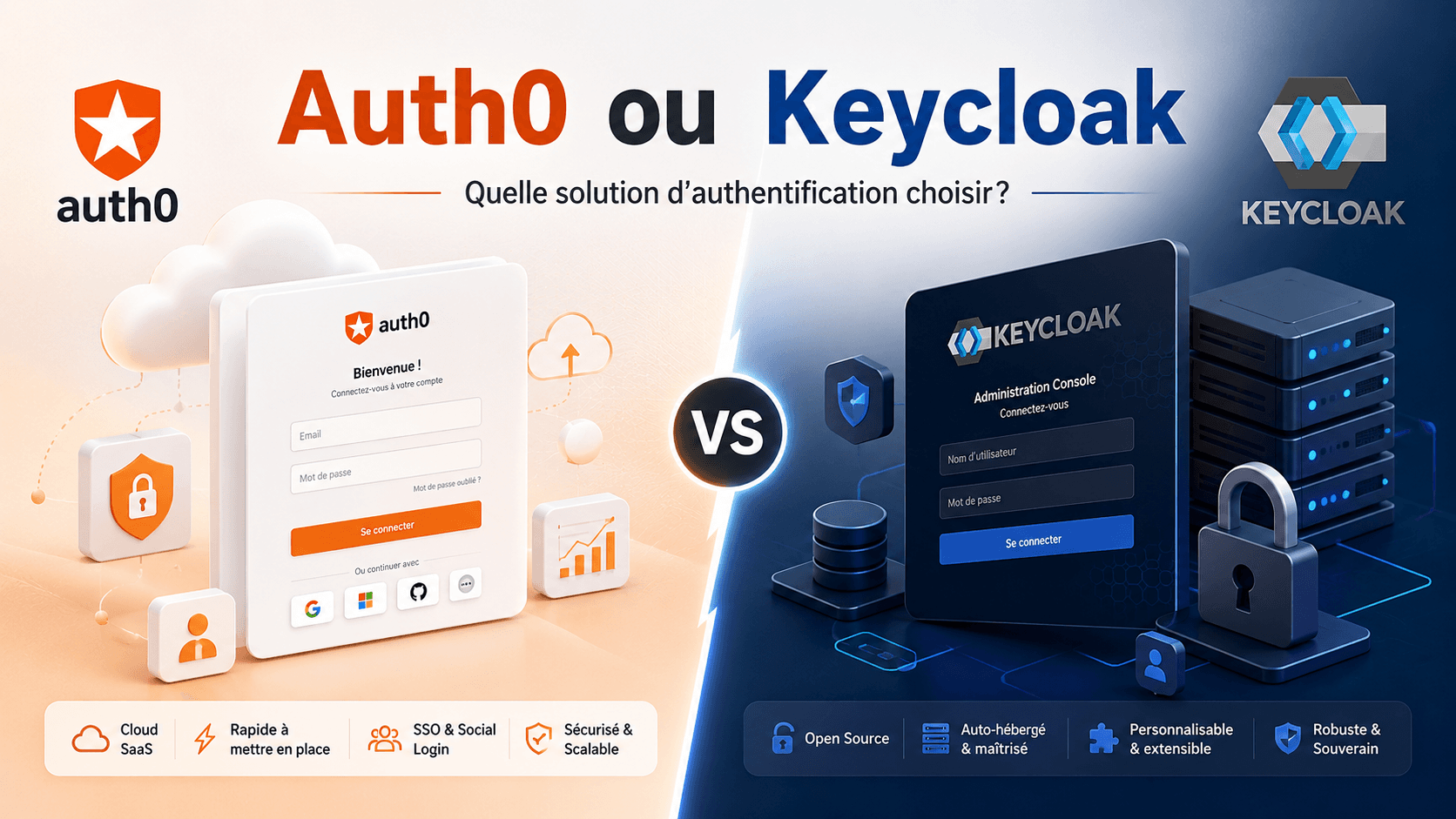
Auth0 is a turnkey authentication service: social login, SSO, MFA, user management, no servers to maintain. It integrates quickly, is robust, and covers complex enterprise needs (SAML, OIDC). The trade-off: a paid SaaS that scales with active users, and your identities reside with a third-party US provider.
The business model deserves stating early, because it is the main reason teams migrate away. According to Auth0’s pricing, billing follows monthly active users: the free tier covers up to 25,000 monthly active users, then paid plans start at $35 a month for 500 users in B2C and $150 in B2B, progressing in tiers, with billing at the next tier up if your volume falls between two. Some features common in enterprise settings, such as enterprise SSO connections or advanced MFA, are separate add-ons. Auth0’s cost therefore follows the product’s success, which is comfortable at the start and becomes a line to watch.
Keycloak: Open Source and Sovereign
Keycloak does broadly the same, SSO, identity federation, SAML, OIDC, fine-grained roles, but it isopen source and self-hostable. Your identities stay on your infrastructure. This is the choice for sovereignty, at the cost of an additional component to maintain (updates, high availability).
The contrast is sharp on the two points that matter. Keycloak is published under the Apache 2.0 licence, open source in the Open Source Initiative sense, with no restriction on commercial use, and the project is hosted by the Cloud Native Computing Foundation. It implements OpenID Connect and SAML, and handles identity federation, fine-grained roles and SSO. No per-user cost: the spending moves from licensing to operations, server, database, version upgrades, availability, backups. So the trade-off is not “paid versus free” but “predictable outsourced cost versus internal operational load”.
And Supabase Auth?
For many applications, the built-in authentication ofSupabase (JWT, roles via RLS, multiple providers) is enough, without adding either Auth0 or Keycloak. We default to it on our projects, seeour Supabase agency.
That option deserves detail, because it is enough in more cases than people assume. Supabase Auth issues a JWT containing the user’s identifier, which the database then uses directly: rights are written as Row Level Security policies, enforced by PostgreSQL itself, row by row, whatever client is querying. That is the structural advantage, the rules do not depend on the application, and the trap at the same time: a table without RLS enabled is readable from the browser using the public key. The check fits in one query made with the anon key, and it belongs in every acceptance test.
How to Choose
- Supabase Auth for most applications: integrated, simple, sufficient.
- Auth0 if you want managed, rich enterprise SSO needs, without strong sovereignty constraints.
- Keycloak whenever identities must stay in-house (sovereignty, sensitive sectors).
The right choice is made during scoping, based on your existing SSO context, a topic we address in ourapplication development and SaaS.
Need help deciding on authentication or SSO? Let’s discuss.
Related articles
Sep 30, 2026
Payload CMS: our review after putting it into production
Payload CMS from the inside: which projects to choose it for, how it changes marketing, what it costs, and the pitfalls of a Webflow migration
Sep 15, 2026
Cyber Resilience Act: reporting obligations took effect on 11 September
Since 11 September 2026, manufacturers must report exploited flaws within 24 hours, including on products already sold. Who is in scope, and what to prepare.
Sep 15, 2026
Health applications: what HDS hosting really requires
The certification covers the host, not your application. The six activities, what the 2024 framework changed, and what stays on your side.