
Blog · Web development
Webflow Localization vs Weglot: Which Solution to Choose?
On this page
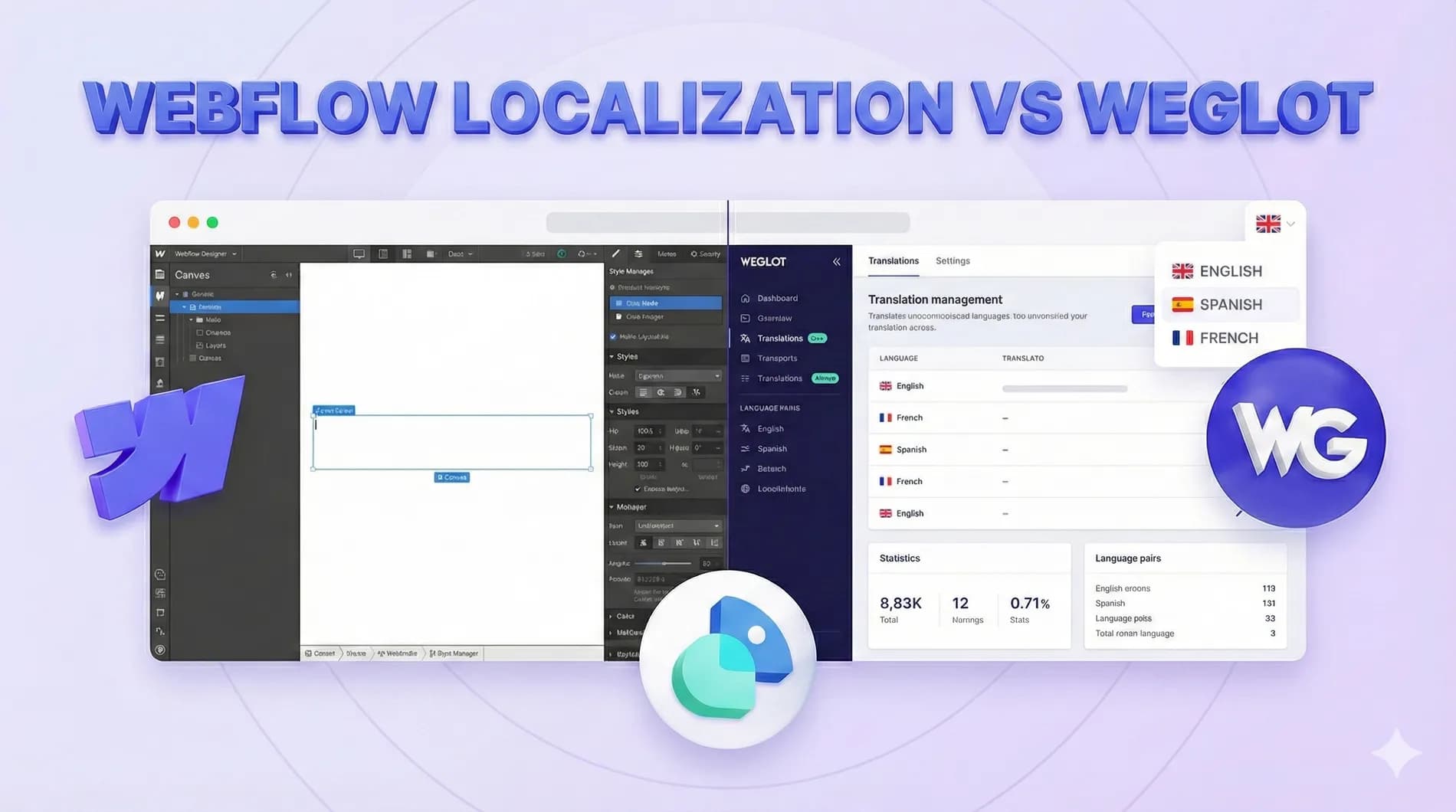
Webflow Localization vs Weglot: Compare features, SEO, pricing, and choose the best multilingual solution for your Webflow site.
When it comes to multilingual sites on Webflow, the choice of tool directly impacts SEO, content management, localization strategy, and even long-term costs. Webflow Localization and Weglot address the same need, translating a site into multiple languages, but with very different approaches.
To put it simply, Webflow Localization is a native feature designed for structured, SEO-focused projects. Weglot is an external tool that prioritizes quick setup and automated translations. The right choice depends mainly on your business goals, SEO strategy, and need for control.
Webflow Localization or Weglot: The Quick Answer
If your priority is SEO, full control over pages, tags, and URLs, Webflow Localization is the most consistent solution. It’s aimed at businesses that see their site as a real lever for growth and visibility on Google.
If your priority is speed, with limited time or internal resources, Weglot can be a good solution to quickly make a multilingual site available, especially for testing a market or an English version.
In most professional projects we support at Scroll, the question isn’t just “how to translate,” but “how to properly localize a site for users and for search engines.”
Webflow Localization vs Weglot: A Comparison
To understand the differences, you need to look at the key features, not just translation.
Webflow Localization is built directly into the Webflow interface. Each language becomes a version of the site, with its own pages, content, images, elements, and SEO tags. Language management is done page by page, with very fine control.
Weglot works as an external layer. The tool detects content, translates it automatically, and displays translated versions via a script added to the site’s code. Management is centralized in Weglot, not in Webflow.
In terms of SEO, Webflow Localization allows precise management of hreflang tags, language-specific URLs, titles, and meta descriptions. Each version is clear for Google. Weglot also handles hreflang, but with less advanced customization, especially for complex projects.
Those tags follow precise rules, and that is where most configurations fail. Google requires the links to be bidirectional: if the French page points at the English page, the English one must point back, otherwise the annotation is ignored. Each page must also list itself. Finally, the hreflang="x-default" attribute names the version to serve for languages not covered, a frequent omission on sites that auto-redirect from the homepage. All three are verified by reading a page's source, not by trusting the tool. Documentation: localized versions according to Google.
In terms of performance, Webflow Localization is cleaner. There’s no heavy external script or dependency on a third-party tool. Weglot remains performant but adds an extra layer of code and processing.
That performance gap is measurable rather than assumed. The Core Web Vitals set three thresholds: LCP under 2.5 seconds, INP at or below 200 milliseconds, CLS at or below 0.1, at the 75th percentile of page loads and segmented across mobile and desktop. A third-party script weighs mainly on the last two: interaction responsiveness, and visual stability if translated text replaces the original after first render. The right method is to measure all three with and without the solution, on a real page, before deciding. Reference: Core Web Vitals.
Webflow Localization: How It Really Works
Webflow Localization is based on a simple yet powerful logic. You create a primary language, often French, then add other languages like English. Each page then exists in multiple language versions.
You can manually translate content, adapt texts, modify images, or change certain elements based on the language or target market. It’s a true localization tool, not just a translation tool.
For SEO, this is a major advantage. Each URL is clean, each page is indexable, and each tag is controlled. Google perfectly understands the site’s multilingual structure, which improves international ranking.
Webflow Localization is particularly suited to businesses that want a solid SEO strategy, with content tailored to each language and real consistency between marketing, web, and acquisition.
The Benefits of Webflow Localization for a Professional Site
The first benefit is control. You retain full oversight of each page, each translation, and each content version. Nothing is automated without your approval.
The second benefit is SEO. Hreflang tags, URLs, titles, descriptions, and even the content itself are optimized for each language. This is a key point for Google ranking, especially in competitive markets.
The third benefit is technical consistency. Everything stays within Webflow. No dependency on external tools, no compatibility issues, and no surprises in the long run.
Finally, Webflow Localization enables advanced customization. You can tailor the messaging, images, calls-to-action, and even the page structure based on visitors and countries.
The limitations of Webflow Localization to be aware of
Webflow Localization requires more initial work. You need to create, translate, and verify each page version. This often involves a real reflection on content strategy and sometimes professional support.
Translation is not automatic. You must rely on human translations or external tools, which can incur additional costs or delays.
Pricing depends on Webflow plans and the number of languages. For some small projects, this may seem more commitment-heavy at first than an all-in-one solution like Weglot.
Weglot: a fast solution for translating a Webflow site
Weglot is designed for speed. Once the tool is connected to Webflow, the site is automatically translated into the selected languages. Content is detected, translated, and displayed without heavy site modifications.
The Weglot interface allows you to manage translations, correct certain texts, and choose which pages are visible per language. It’s simple and accessible, even without advanced technical skills.
For businesses looking to test a market, quickly offer an English version, or make a site accessible to international visitors without a full redesign, Weglot can be an effective solution.
The strengths of Weglot
Setup is very fast. In just a few hours, a Webflow site can become multilingual.
Automatic translation covers a lot of content without immediate effort. This is practical for sites with many pages or projects in the launch phase.
Weglot handles the basics of multilingual SEO, such as hreflang tags and the indexing of translated pages by Google. For simple needs, this may suffice.
The limitations of Weglot in the long term
The main drawback is control. The content remains dependent on Weglot. Pages are not truly managed in Webflow, which limits advanced customization.
Costs increase with the number of words, languages, and pages. For sites that evolve rapidly, the bill can quickly rise.
In terms of SEO, Weglot is less flexible. Fine-tuning optimizations, content adaptations per language, and advanced referencing strategies are more complex to implement.
Multilingual SEO: which solution is the most effective?
If SEO is a central part of your strategy, Webflow Localization clearly has the edge. Google favors sites with a clear language structure, distinct URLs, truly localized content, and perfectly configured tags.
Webflow Localization allows you to treat each page as standalone content. This is ideal for an international search strategy, with specific keywords per language and market.
Weglot offers a decent SEO solution for simple needs but shows its limits when aiming for fine-tuned optimization or adapting content to local search intents.
Pricing and cost logic
Webflow Localization is integrated into Webflow plans Webflow with a cost per language. The investment is more predictable and aligns with a long-term vision.
Weglot operates on a subscription basisbased on the number of words translated. The larger the site grows, the higher the cost. For some projects, this can become a barrier over time.
That billing unit deserves understanding before committing, because it behaves unlike the others. What counts is not visitors or page views, but the volume of translated words, and a blog publishing two articles a week grows that volume without ever shrinking it. The cost therefore tracks editorial output, not audience. Conversely, a stable forty-page brochure site stays on a predictable bill for years. It is that trajectory, more than the entry price, that should drive the choice. Grid: Weglot pricing.
The choice shouldn’t be based solely on the displayed price, but on the website’s role in your overall strategy.
Which solution to choose based on your Webflow project?
For a simple showcase website, with few pages and a quick need for multilingual support, Weglot can be a pragmatic solution.
For SMEs, startups, or businesses focused on the web, SEO, and lead generation, Webflow Localization is often the best choice. It provides a solid foundation for scaling, optimizing, and converting.
For e-commerce projects, high-traffic websites, or ambitious international strategies, the control and customization offered by Webflow Localization clearly make the difference.
And now, how can you move forward confidently with your multilingual project?
Choosing between Webflow Localization and Weglot isn’t just about the tool. It’s a strategic decision that impacts your visibility, your users, and your ability to scale your website.
At Scroll, we support businesses in creating Webflow websiteshigh-performing, multilingual, and SEO-optimized. Our services include audits, SEO strategy, Webflow Localization implementation, translation optimization, and team training. The goal remains the same: turn your website into a true growth driver, in both French and English.
Is Weglot compatible with Webflow?
Yes, Weglot works very well with Webflow via a script. It allows you to quickly translate a Webflow site without altering its structure, but with less control over content and SEO optimisation.
Which solution should I choose for a professional multilingual site?
For a growth-focused, SEO-optimised, and customisable site, Webflow Localization is the better choice. Weglot is more suited to simple projects or quick tests in a new language.
Does Webflow Localization offer automatic translation?
No, Webflow Localization focuses on localisation. Translations must be done manually or via external tools, which allows for better control over content quality.
Which solution is the most cost-effective in the long run?
Webflow Localization is often more cost-effective for businesses. Costs are predictable per language, whereas Weglot becomes more expensive as the number of pages, words, and languages increases.
Related articles
Sep 15, 2026
Cyber Resilience Act: reporting obligations took effect on 11 September
Since 11 September 2026, manufacturers must report exploited flaws within 24 hours, including on products already sold. Who is in scope, and what to prepare.
Sep 15, 2026
Health applications: what HDS hosting really requires
The certification covers the host, not your application. The six activities, what the 2024 framework changed, and what stays on your side.
Sep 08, 2026
Digital accessibility: who is covered, and where to start
Two regimes, a decree in force since 27 August 2026, fines up to 50,000 euros. Who has to comply and where to start.