
Blog · AI
SEO & AI: Optimizing Your Ranking on ChatGPT
On this page
AI SEO: Discover how to optimize your content with ChatGPT to drive more traffic, improve rankings, and generate more leads.
SEO is no longer just about Google. With artificial intelligence and ChatGPT, your ranking must now appeal to search engines as well as conversational engines.
How can you get ChatGPT to cite (or use) your content?
In reality, you can’t “force” ChatGPT to use your content. However, you can make your site far more appealing to search engines and the AI systems that rely on them.
How ChatGPT Sees the Web and Websites
ChatGPT is trained on vast amounts of data from the web, including websites, articles, search result pages, and other sources. When connected to search, it relies on engines like Google or Bing to fetch fresh information, then rephrases it.
In practical terms, this means that if you already have strong SEO on traditional engines, your content is more likely to be included in AI responses. The most prominent content characteristics are quite similar to those of good traditional SEO:
One technical lever does exist, and it is directly actionable: OpenAI publishes the list of its crawlers and how to allow or block them in robots.txt. Three matter most, and conflating them is costly. OAI-SearchBot surfaces a site in ChatGPT's search results; GPTBot collects content that may be used to train the models; ChatGPT-User corresponds to a visit triggered by a user. They are configured independently: you can allow the first to be cited while blocking the second to stay out of training. Many sites block everything as a precaution and forfeit the citations. Allow roughly 24 hours for a robots.txt change to be picked up. Documentation: OpenAI's crawlers.
- high-quality, well-structured, up-to-date content
- pages that already rank among the top results for a search
- websites with strong authority, clean links, and minimal spam
- precise, sourced, factual information
By refining your AI SEO, you’re not working against search engines, you’re strengthening your signals across the entire search ecosystem and every engine that relies on it.
SEO Signals That Also Help AI (Google, Bing, ChatGPT)
Many ranking signals that benefit Google or Bing also indirectly help ChatGPT and other AI tools.
Here’s a table to clarify these connections.
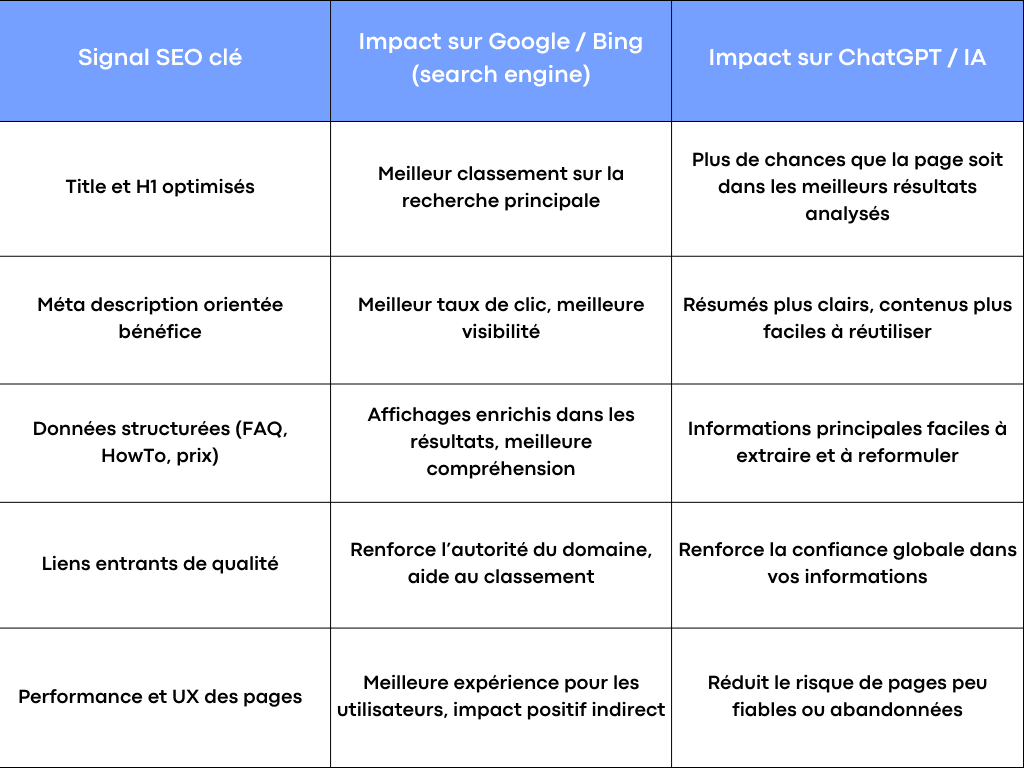
The Link Between SEO and AI
Simple translation: If you’re already optimizing for traditional SEO, you’re laying the groundwork for AI SEO.
Google says exactly the same thing in its own documentation, and its wording is useful because it also closes off a few false trails. The generative AI optimization guide files special files like llms.txt under things to ignore, they "neither harm nor help", Search ignores them, along with artificial content chunking and rewriting aimed at machines. What it recommends instead comes down to three points: technical fundamentals, unique content backed by real expertise, and tracking through Search Console's generative AI performance report. Documentation: Google's generative AI optimization guide.
Building an AI SEO Strategy for Your Website
Before launching content tasks or generating content with AI, you need a framework. Your strategy should first address the real needs of your users and your business, not just current trends.
Define Your Goals and Users
An effective AI SEO strategy starts with three simple questions.
What are your primary goals?
You're looking for more quote requests, more calls, more e-commerce sales, more appointment bookings,greater local visibility in a specific region. The answer shapes the content, pages, site structure, and how you highlight prices, offers, or guarantees.
Who are your users?
For an SME or a small business, users are often decision-makers short on time. They want clear information, simple language, concrete examples, and quick results. They’re not doing theoretical research, they want to solve a specific problem.
What role does your website play in the journey?
Your website may not be your only marketing channel. But it remains the foundation for your SEO, your content, and your key pages. It’s the reference that search engines and AI tools will analyze first.
Demand analysis: traditional keyword research + AI
For the research part, the winning combo is simple: an SEO tool for data and AI for creativity.
You use a tool like Semrush to:
- identify search volumes
- spot your competitors’ keywords and their top-performing pages
- track your ranking changes on strategic pages
At the same time, you can use ChatGPT as a brainstorming tool to generate:
- lists of content ideas around each topic
- questions your users might type into Google or Bing
- different marketing angles on the same theme
The challenge is to combine both: data on one side, creativity on the other. This reduces the risk of producing content that doesn’t answer any real search intent.
Structure your pages for search engines and ChatGPT
A good AI SEO page is easy to read for humans and easy to analyze for search engines.
A few simple guidelines for structure:
- an H1 that clearly states the topic, with your primary keyword (e.g., AI SEO, AI SEO audit, AI SEO strategy)
- H2s and H3s that break information into logical sections
- a first paragraph that summarizes the main answer to the search query
- a meta description that highlights the benefit, with an action verb and the page’s key terms
- an internal linking structure that connects the page to other useful content on the site
For conversational engines, this structure is ideal. AI can quickly identify key information, rephrase it, and integrate it into a result.
“Answer-ready” content: writing for conversational engines
Writing for AI doesn’t mean writing for robots. On the contrary, it requires refocusing on user needs.
Google's position on generated content is more nuanced than the shortcuts in circulation: using AI is not in itself grounds for a penalty; using it "primarily to manipulate ranking" is. The criterion remains quality and usefulness for readers, however the text was produced. That shifts the question: it is not whether you may use AI, but whether what you publish adds something that did not already exist elsewhere. Documentation: Google on AI-generated content.
To make your content “answer-ready”:
- start each section with a short sentence that provides the essential answer
- then expand with examples, real-world cases, and simple figures
- avoid jargon, prioritize simplicity, especially if you’re targeting executives who don’t have time to decode everything
You can of course use AI to generate a first draft, but the core work remains adaptation: tone, marketing angle, information selection, and quality control. This is where the difference lies between average content and content that truly boosts your SEO and brand image.
Leveraging ChatGPT and AI tools for your SEO
AI should be a tool to accelerate your SEO tasks, not a magic wand that replaces expertise.
Using AI for keyword research and content ideation
ChatGPT can help you:
- explore new topics around a strategic theme
- find complementary article ideas for a service page
- imagine different content formats for the same search intent
You start with a data-driven foundation (for example, a list of keywords from Semrush), then ask AI to suggest related content, recurring questions, or marketing angles.
The goal isn’t to blindly follow these ideas but to filter them using your industry expertise, search data, and positioning.
AI-assisted writing and page optimization
For writing, AI can intervene at multiple levels.
First, in the brief. You define the primary keyword, marketing goal, user type, competitor pages to outperform, target length, and tone characteristics. ChatGPT can then propose a page structure, titles, and a description.
Next, for variations. For the same content, you can generate multiple versions of titles, meta descriptions, or intros. You keep the best ones, optimize them, and add your own phrasing.
Finally, for rewriting. You can simplify overly technical passages, rephrase sections, or lighten dense blocks. The goal is to improve readability while preserving your brand voice.
In any case, human validation remains mandatory. You check the facts, figures, names, links, prices if mentioned, and ensure the page truly serves your overall strategy.
Using AI effectively in SEO
AI SEO opens up many possibilities, but if misused, it can also damage your image, content, and rankings.
When AI drags the quality of your content down
The classic risks:
- highly generic content that resembles competitors’ sites, lacking personality
- approximate or sometimes false information, which can be problematic for sensitive topics
- a “hollow text” impression, with many words but little useful information
For an SME or a small business, the temptation to automate everything is strong to save time and reduce the cost per page. But low-quality content is actually more expensive in the long run, as it generates neither lasting visibility nor conversions.
Frame AI with simple best practices
To maintain a high quality standard while leveraging artificial intelligence, a few principles are enough.
- every important piece of content (service page, key guide, pricing page, landing page) must undergo human validation
- systematically add elements AI cannot invent: examples from your clients, real figures, internal processes, GEO-specific details, differentiating factors from competitors
- maintain a clean SEO structure: clear title, unique H1, optimized meta description, coherent internal linking, carefully selected external links
- update your strategic pages as soon as your offers, prices, or services evolve
The end goal remains the same: useful content for your users, aligned with your marketing strategy, whether for traditional search or conversational engines.
What if we took stock of your AI SEO together?
Implementing a real AI SEO strategy takes time, tools, analysis, and a clear vision of your marketing goals. You can of course start testing things with ChatGPT, generating some content, and optimizing a few pages, but the real potential unlocks when everything aligns: website, content, offers, data, SEO, and internal resources.
This is precisely the kind of topic on whichthe Scroll agency supports SMEs and small businesses. Website audit, prioritization of key pages, content strategy, smart integration of artificial intelligence into your daily tasks, tool selection, implementation of a realistic optimization plan.
If you feel AI SEO is important for your business but you don’t have the time or desire to dig into it alone, the simplest solution is to discuss it together, review your current sites, results, and competitors, and define the next steps, calmly but effectively.
How can I tell if my content is being used by ChatGPT or another AI?
You can’t measure this precisely. However, if your pages rank well on search engines, if you have high-quality content on your topics, if third-party sites cite you and link to you, you increase your chances of being used by AI engines. Some customers will also tell you directly when they found you through an AI search.
Should I completely change my SEO strategy for artificial intelligence?
No. There’s no need to discard everything you’re doing. Instead, strengthen the fundamentals: content quality, clear structure, strong technical signals, reliable data. Then, add an AI layer to speed up certain tasks, better understand user expectations, and produce more comprehensive pages.
How can I avoid issues with Google if I use AI-generated content?
Google does not penalize content solely because it’s AI-generated. However, it does penalize low-quality content. The key is simple: never publish raw text straight from a tool. Proofread, edit, enrich, add your expertise, your data, your examples. Maintain your quality standards, even if AI helps you produce faster.
Will SEO disappear with AI and conversational search engines?
No, SEO is evolving but not disappearing. As long as there are search engines, there will be a need for visibility, ranking, and optimization. Artificial intelligence is changing the format of results and pages, but the need to organize information, create useful content, and guide users to the right sites remains the same.
Related articles
Sep 22, 2026
Jev: the AI model that decides instead of writing
Launched in September 2026 by TypeSafe AI, Jev does not generate text: it returns typed, calibrated decisions. What it is, what it costs, and three use cases.
Sep 07, 2026
How much does an AI project cost, from POC to production?
The model price is not the point. Where the budget actually goes, how to calculate the API versus dedicated server threshold, and what makes it slip.
Aug 28, 2026
AI Act: what actually applies since 2 August 2026
The Digital Omnibus pushed high-risk obligations to December 2027. What already applies, what was postponed, and what to do in between.